Prediction-market odds beside prices and in the Predictions section
On this page
A prediction market is a place where people trade contracts on what will happen, and the price of a contract is the crowd's estimate of how likely it is. Finance puts those prices where they are useful: beside the stocks, indexes, coins and economic figures they are about, and on a Predictions section of their own. For what prediction markets are and how they work, see Predictions.
#Where the odds appear
-
The overview has a Prediction markets card with tiles for the next Fed decision, a recession, the next inflation reading and the S&P 500.
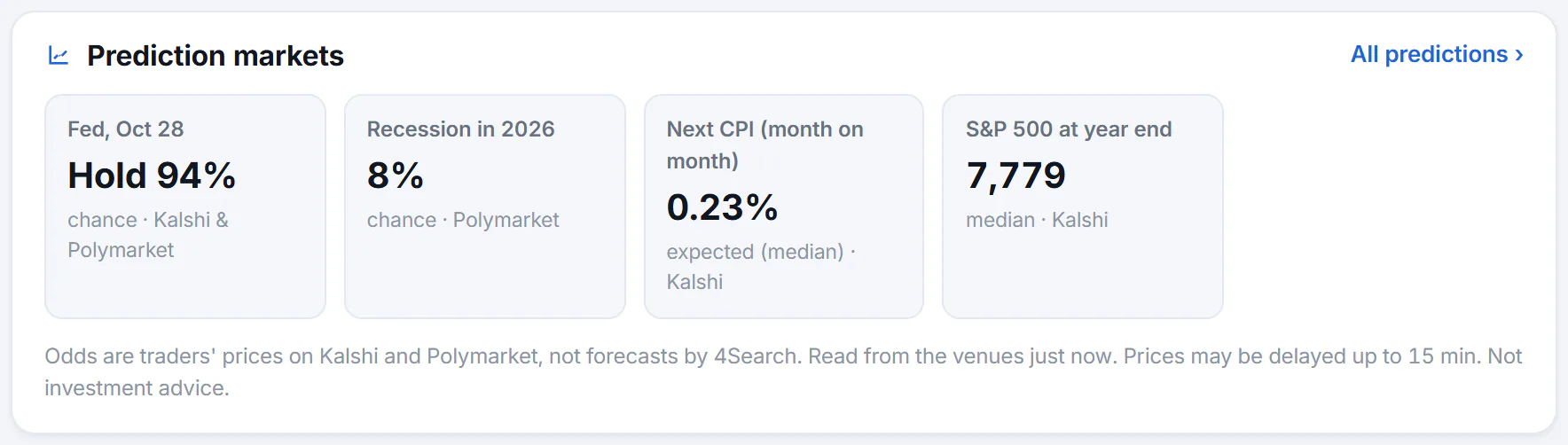
The overview's tiles. Each gives a headline number and what it means.
- 1A headline number and what it means
- 2Every prediction market
- 3Odds are traders' prices, not a forecast
-
An "Odds" label beside a name in a table means prediction markets have markets about it. Select it to see them.
-
A stock's or other instrument's page has a Prediction markets card in the side column, and, when three or more markets are about it, a Predictions tab.
-
The economy page shows what traders expect for the next release of inflation, jobs and growth figures, and the path of the Fed. See The U.S. economy.
-
The earnings calendar shows a Beat label, the odds that a company beats its estimate. See The earnings calendar.
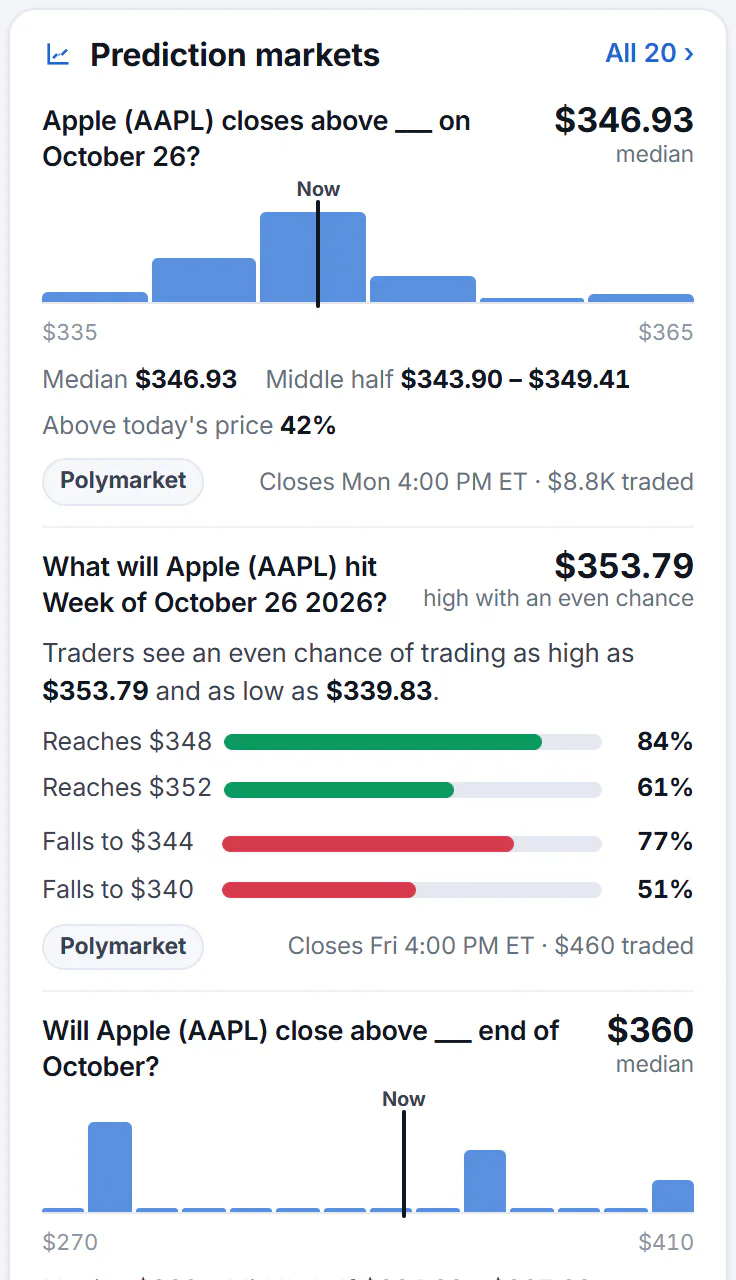
On a stock's page. The first market gives a median closing price; the second gives the chance of reaching each price.
- 1The headline number: a median price, or a chance
- 2Which venue the odds come from
- 3The chance of reaching each level
- 4All the markets about this stock
#How to read a card
The price of a contract that pays $1 if something happens is its probability: a contract at 84 cents means traders give it an 84% chance. The number shown is the midpoint between the best buy and sell offers, or the last trade when those offers are more than ten cents apart. Cards come in a few shapes:
- A chance. A big percentage, such as 8% chance of a recession in 2026.
- A choice. Each outcome with its chance, such as Cut, Hold and Hike for the Fed.
- A median and a range. For a number such as a closing price or an inflation reading, the markets list several levels ("above $345, above $350 ..."). Their odds together make a picture of what traders expect. The median is the level where traders see an even chance either way, the middle half spans from the 25th to the 75th percentile, and the bars show where the odds are concentrated.
- A chance of reaching a price. Reaches $352 or Falls to $344 is the chance that the price touches that level during the period. A line such as "high with an even chance" gives the level traders see an even chance of reaching. Already reached lists the levels the price has already touched.
Under each card is the venue it comes from, when it closes and how much has been traded. A market with little trading is shown muted, and markets with no real quotes are left out.
#The Predictions section
Open Predictions in the Finance section bar.
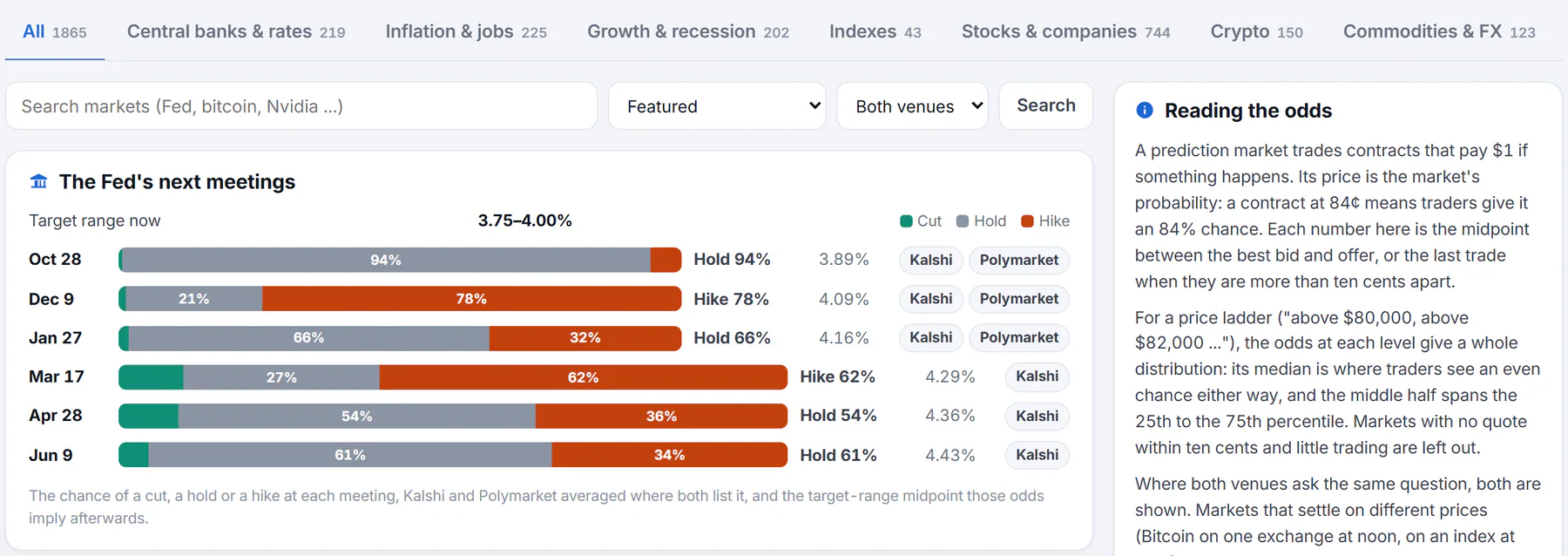
Category tabs with the number of markets in each, search and sort controls, and the Fed meetings card.
- 1Categories, with how many markets each holds
- 2Search, sort and choose a venue
- 3The chance of a cut, a hold or a hike at a meeting
- The tabs sort markets into All, Central banks & rates, Inflation & jobs, Growth & recession, Indexes, Stocks & companies, Crypto and Commodities & FX, with the number of markets in each.
- The search box finds markets by words, such as
Fed,bitcoinorNvidia. The menus order them as Featured, Most traded today, Closing soonest, Biggest moves today or Newest, and narrow them to one venue or both. - On All, the top cards are The Fed's next meetings, Headline odds and Where the venues differ, then Biggest moves today, Closing this week, Most traded and Recently resolved.
The venues are Kalshi, a regulated U.S. exchange, and Polymarket. Where both ask the same question, both are shown. Where they would settle on different prices, they are shown side by side and never averaged. The Fed meetings card, where both list the meeting, averages the two. The page's side card Reading the odds repeats how to read a card.
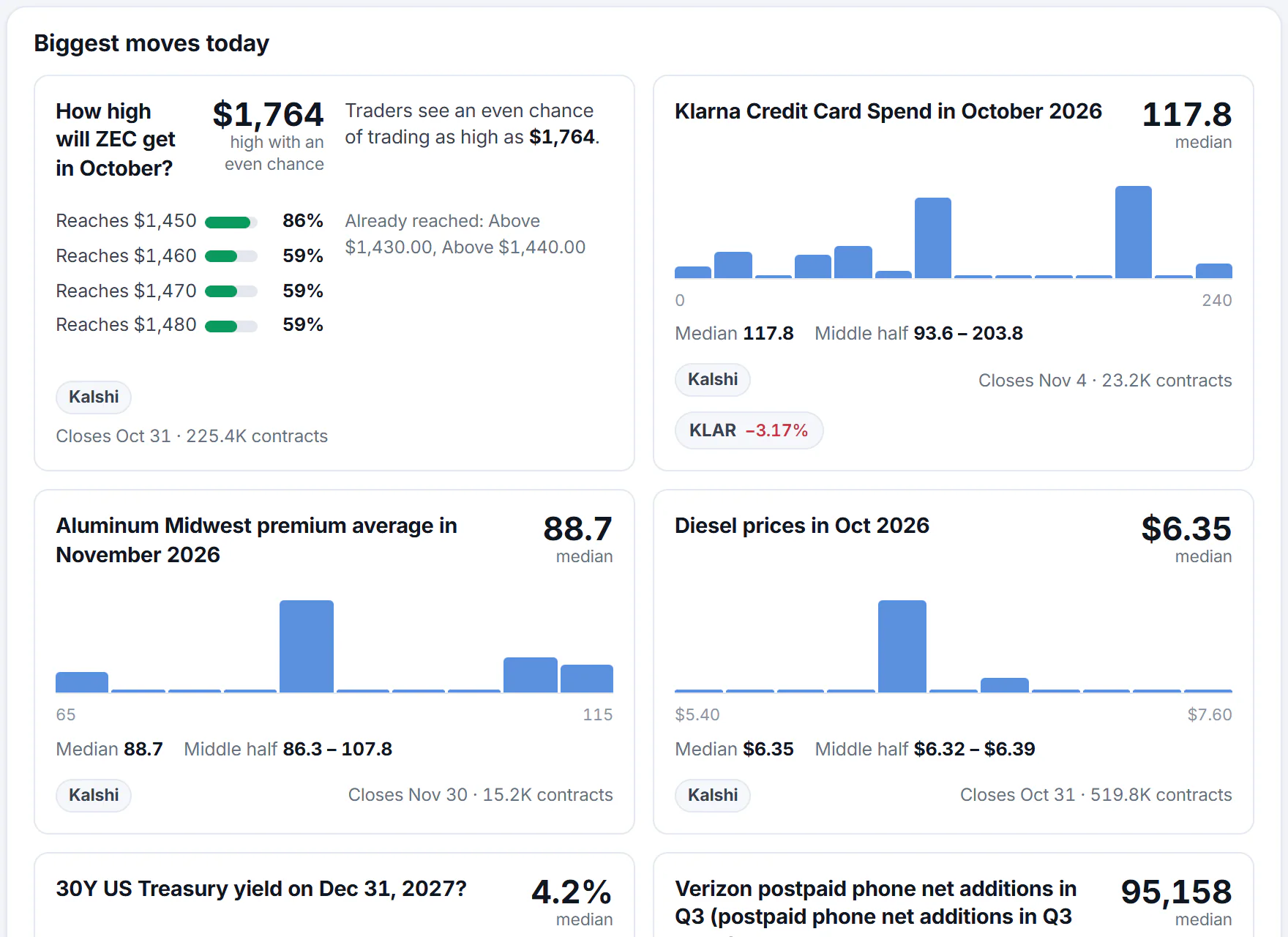
Cards from Biggest moves today. The big number is the headline; the footer shows the venue, when it closes and how much was traded.
- 1The headline number
- 2Venue
- 3When it closes and how much has been traded
#One market's page
Select a market's question to open its own page: the question and venue, The odds at full size, How the odds have moved over 1W, 1M, 3M or All, Every outcome, the same question on the other venue, and related markets. The side column has About this market (what it settles on, when trading closes, how much has traded), the instruments it is about, and, where there is one, a link to the same market on the Predictions service, with its news.
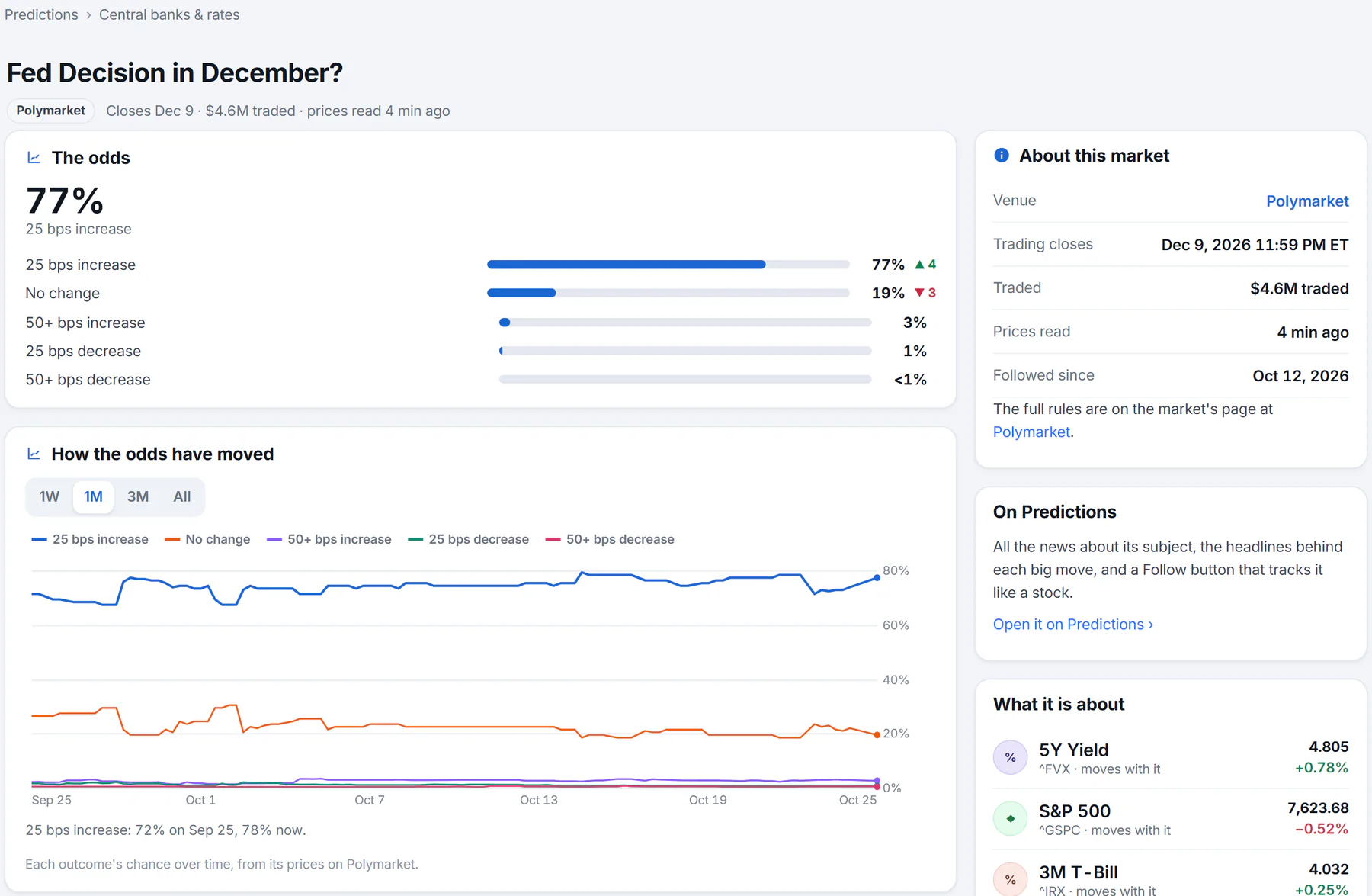
A market's own page: the odds now, and how they have moved.
- 1The question, its venue and when it closes
- 2The odds at full size
- 3How the odds have moved
A market that has settled shows Settled with the result and what traders gave it a day before.
Prediction markets on elections, sports, culture and world events are in Predictions.
#Common questions
Is an 84% chance a promise?
No. It means traders priced it that way, and an outcome priced at 84% still fails some of the time.
How current are the odds?
They are read from the venues every few minutes. Each page says how long ago, for example Read from the venues 4 min ago.
Why do two venues show different odds for the same question?
Each venue has its own traders and its own rules. Finance shows both, and says when the numbers are far apart.
Can I bet here?
No. Finance shows the odds only. It does not trade, and the links to the venues are for reading.